
 Indonesia
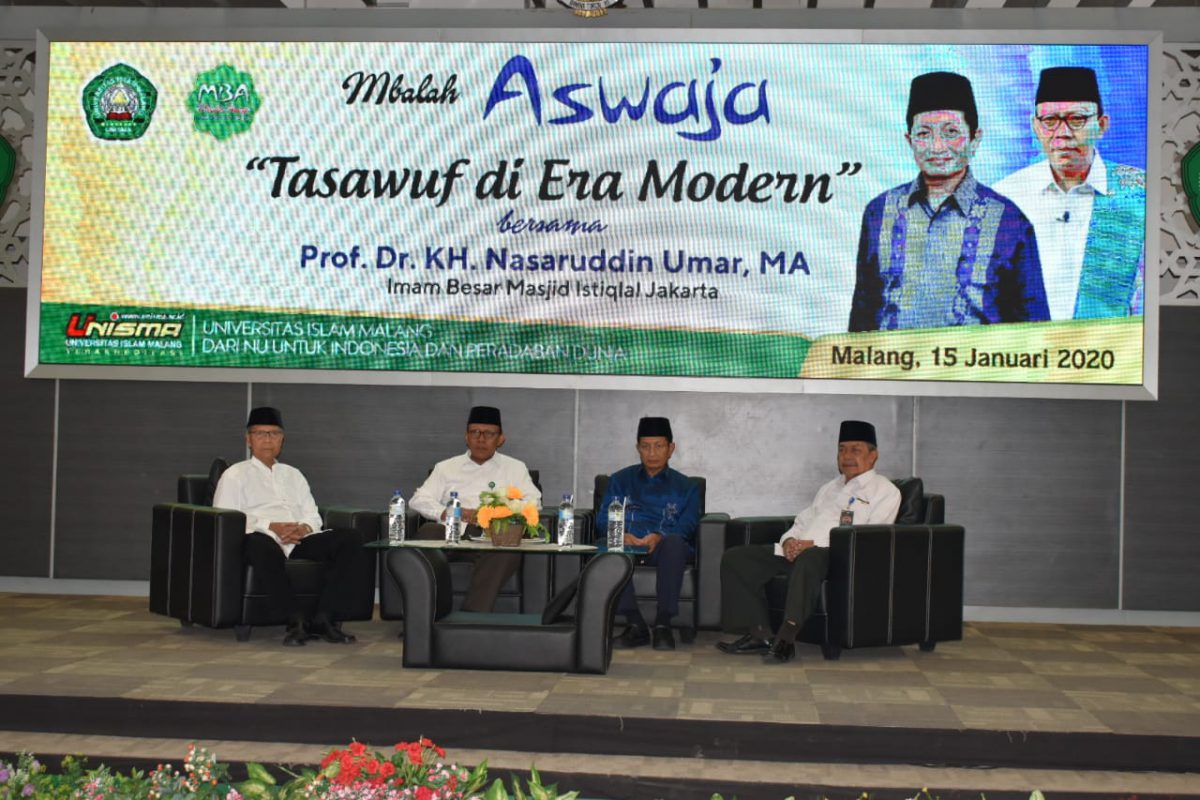
Prof. KH. Nasaruddin Umar, MA., Ph.D., encouraged all administrators, faculty members, and staff at Universitas Islam Malang (UNISMA) to learn from the “Impersonal Teacher.” The message, delivered during Mbalah Aswaja forum titled “Sufism in the Modern Era” on Wednesday, January 15, 2020.
He began his explanation with Q.S. Al-Baqarah: 151, which reads:
كَمَا أَرْسَلْنَا فِيكُمْ رَسُولًا مِنْكُمْ يَتْلُو عَلَيْكُمْ آيَاتِنَا وَيُزَكِّيكُمْ وَيُعَلِّمُكُمُ الْكِتَابَ وَالْحِكْمَةَ وَيُعَلِّمُكُمْ مَا لَمْ تَكُونُوا تَعْلَمُون
Meaning: As We have sent to you a Messenger (Muhammad) from among yourselves who recites Our verses to you, purifies you, and teaches you the Book (the Qur’an) and Wisdom (the Sunnah), and teaches you what you did not know. (Q.S. Al-Baqarah: 151)
In this verse, who is the Messenger referred to? The use of word “rasulan” in this verse is in the indefinite form, which means “general,” explained the professor from UIN Syarif Hidayatullah Jakarta. It is possible that this Messenger refers to our scholars, including KH. Tholchah Hasan. While reminiscing about his journey with KH Tholchah, he mentioned that Unisma is a blessing from KH Tholchah Hasan.
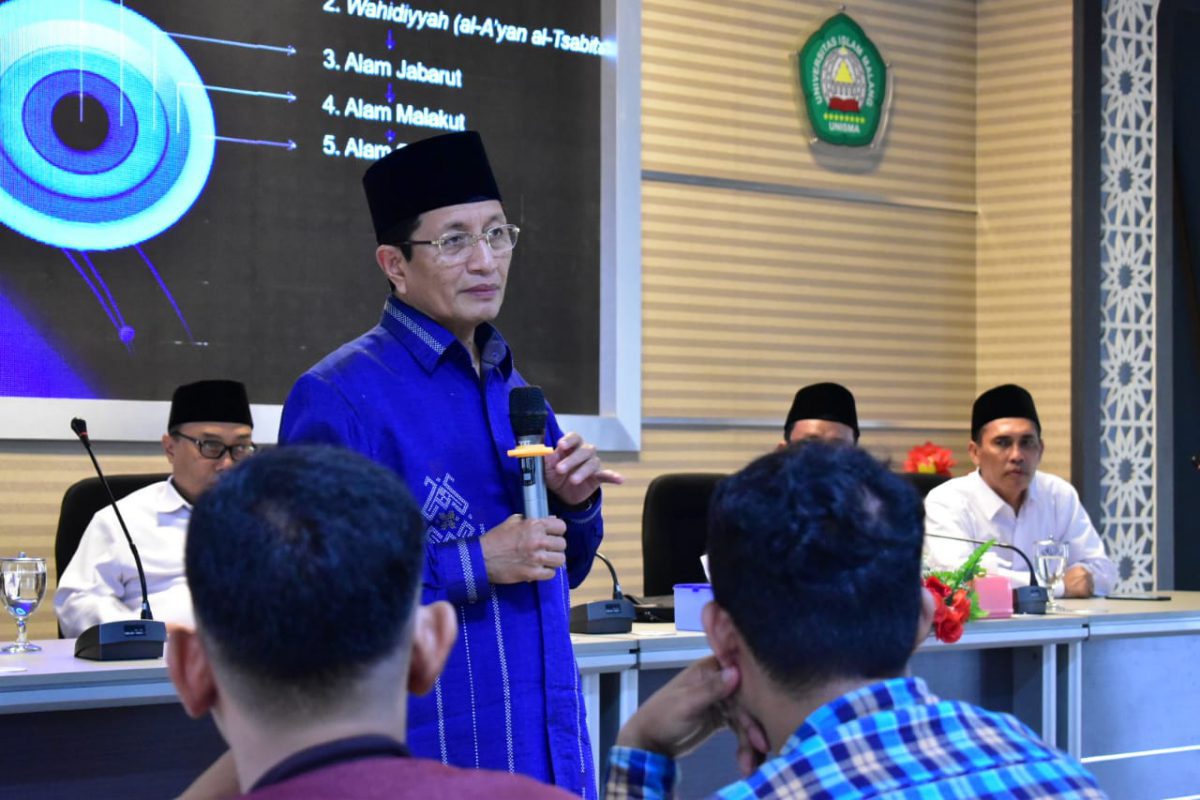
Prof. KH. Nasaruddin Umar, MA., Ph.D., delivered a presentation.
The Rector of Institute of Quranic Sciences (PTIQ) briefly spoke about the virtues of Sholawat Badar. An intriguing question is: why must we stand when the Sholawat Badar is recited? A scholar simply answered that if a head of state is present, we are required to stand. How much more so when the spirit of the Prophet and the Messenger is present? As Muslims, we must certainly show even greater respect.
The verb in this verse uses the fi’il mudhori’; one of the meanings of fi’il mudhori’ is as both the present and future tense. “This serves as a sign that the Prophet has not passed away, but will continue to guide and purify his followers,” he explained on the 7th floor of Ali bin Abi Thalib Building.
Challenges in Translating the Quran
The Grand Imam of Istiqlal Mosque also mentioned the Ministry of Religious Affair’s translation as the best available in Indonesian; however, one should not stop at this translation. To truly understand the meaning and intent of the Quran, one must study Arabic. He explained that the Ministry’s translation is intended only for the general public, as it contains explanations that might dilute the intended meaning of Al-Quran as the Word of Allah.
Linguistic differences cannot be easily and directly translated. Some Arabic words cannot be accurately rendered in Indonesian. In fact, there are Arabic terms for which there are simply no exact equivalents in Indonesian.
Read also: A Website Is a Gateway to the World
As long as a person has not learned from an impersonal teacher, they have not truly learned. Prof. Nasaruddin explained that the Quran, the hadith, and spiritual experiences all point to how humans must learn from an impersonal teacher. Prophet Moses, for example, learned from a tree when he was lost with his wife, and Prophet David learned from a bird.
Current learning relies solely on rational deduction, whereas by learning from an impersonal teacher, we open ourselves to other forms of knowledge beyond that which relies on rational deduction. (AL/PPS)
