
 Indonesia
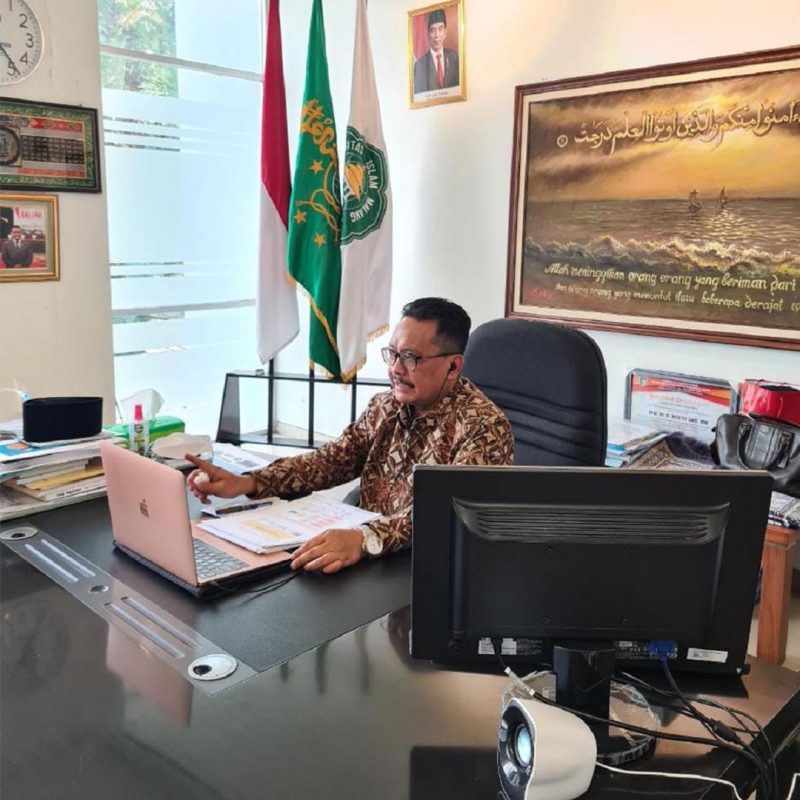
The election is still set to take place next year, but the political machinery is already starting to rev up. Political parties have already declared their presidential candidates, but none have yet named a vice presidential candidate. Here is a response from Prof. H. M. Mas’ud Said, Chair of PW ISNU East Java.
AULA Magazine Issue 06 SNH XLV June 2023
Does the selection of a vice presidential candidate have a significant impact on vote counts?
The selection of a vice presidential candidate for the upcoming 2024 election plays a significant role in increasing the chances of winning. A vice presidential candidate is seen as capable of broadening and expanding support alongside their running mate. Therefore, there are at least three factors that political parties must consider when selecting a vice presidential candidate.
What are these three factors?
First, in terms of electability. The chosen vice presidential candidate is required to complement the voter base or ideology of each presidential candidate. Second, it is important for the vice presidential candidate to possess the necessary capabilities and experience. Whether as a unifier or a government administrator. Third, they must have the necessary logistics or funding. It is essential that a vice presidential candidate also be able to help cover political expenses during the election campaign, given the enormous costs involved.
With these three variables, a vice presidential candidate can function optimally as a “wild card” for the presidential candidates currently in the race, as they possess the full resources needed to compete in any situation.
Isn’t the position of vice presidential candidate non-strategic? How could it possibly determine the presidential candidate’s victory?
In election theory, victory is determined jointly by the figures and strengths of both the presidential and vice presidential candidates. Because even if a presidential candidate leads in public polls, if their running mate doesn’t contribute votes, they’ll still lose. In fact, they’ll lose to a presidential candidate ranked second in the polls but with a strong running mate.
A political analyst predicts that choosing the wrong vice presidential candidate will cause trouble and make it difficult to secure victory. This is the “five-finger theory” I’ve developed. So, if a presidential candidate’s poll numbers are like the middle finger, and their vice presidential candidate’s numbers are like the pinky finger, they’ll lose to a presidential candidate whose poll numbers are like the index finger but whose vice presidential candidate’s numbers are like the ring finger. Try calculating it by arranging the heights of our five fingers.
The position of vice president in a presidential system is indeed highly contested, as it plays a strategic role in government. In the 2024 election, the competition is indeed extraordinary, even though the role itself is fairly routine. However, the vice presidential position is strategically significant within the government. In a presidential system, both the president and the vice president constitute a single institution known as the Presidential Office.
But in reality, is the vice president merely as a spare tire?
That’s right. The vice president serves as a backup to replace the president when the president is unable to perform his duties under certain circumstances; that is the function within the constitutional system. Just like a spare tire on a vehicle, it is only used when the main tire has a problem; only then is it brought in to carry out the presidential functions.
However, in addition to representing the president and carrying out presidential duties, the vice president also assists with presidential tasks delegated in certain areas or responsibilities. For example, we can look at the role of the vice president during President Soekarno’s time, who formed the “Dwi Tunggal” (Dual Leadership) with Bung Hatta. Or the vice presidents during the administrations of Pak Harto (Soeharto), Gus Dur (KH Abdurrahman Wahid), Ibu Mega (Megawati Soekarnoputri), Pak SBY (Susilo Bambang Yudhoyono), and Pak Jokowi (Jokowi). Each had their own distinct differences.
What about vice presidential candidates within the NU sphere?
In the context of the 2024 presidential election and even previous ones, this is indeed highly significant. It could even be decisive. The reasons include the fact that the NU community is the majority, and many NU figures or even structural leaders strongly wish to support their own cadres. Some want a NU figure to become a vice presidential candidate or even a presidential candidate based on their stature, bureaucratic or legislative experience, or experience as a minister, governor, or chair of a NU-affiliated organization, or because they have a large following.
What do you think NU’s standards are in this case?
The term “NU” encompasses various factors. First, NU activists who have successfully led NU autonomous bodies, headed NU institutions, or even served as executives at the PBNU or PWNU levels. Second, those whose lineage traces back to the founders, or their children, or even their grandchildren, or the second and third generations of PBNU.
Third, even if they are not part of NU’s leadership or the broader NU family, they are certainly the heads of NU Islamic boarding schools or leaders of institutions ideologically affiliated with NU. For example, scholars at NU universities, or people born and raised in NU boarding schools or educational institutions.
Fourth, included in the NU circle are national figures who lead dzikir assemblies, Sufi order guides, or national preachers, whose ideology aligns with the devotional practices of NU members.
Read also: Khofifah Indar Parawansa: A Talented Technocrat Who Has Enhanced East Java’s Prestige in Europe
Several NU officials, including those from affiliated organizations, have spoken out about the criteria for vice presidential candidates. What does this phenomenon signify?
So far, membership surveys and election results since the 2009, 2014, and 2019 presidential elections have shown consistent data. In fact, the trend has strengthened. It indicates that if the vice presidential candidate is a strong figure from NU, one who represents the psychological needs of NU communities and the NU community, then they will win.
In the current situation, a vice presidential candidate will be sought who can complement the presidential candidate, such as someone with political experience and leadership skills, or a technocrat, and who is decisive in terms of electoral appeal and electability. But no matter how strong the composition, if it doesn’t win the election, it’s useless. Because in this presidential election, there is no incumbent, and the margins of electability for all presidential candidates are very narrow. No one is certain to exceed 60 percent.
For example, the eras of Mr. SBY and Mr. Jokowi can serve as examples. Mr. SBY chose Mr. JK (Jusuf Kalla), a NU figure, as his vice presidential candidate in his first term. Similarly, during Mr. Jokowi’s first term, he partnered with Mr. JK, who is also notably a NU figure, and even served on the PBNU Mustasyar Council. In his second term, Mr. Jokowi partnered with KH Ma’ruf Amin, who at the time served as Rais Aam of PBNU.
It has been emphasized that NU will not engage in practical politics, including supporting a particular presidential candidate, could this still happen?
Muslims, in the era of NU’s freedom and openness, drawing on the styles of NU leaders, NU’s political traditions, and the political acumen cultivated within NU, will be able to address this in the NU way. NU already has political guidelines for its members, which were adopted at the 1989 Congress in Krapyak, Yogyakarta. Perhaps these will serve as a guide for NU members in their political activities.
Author: Rofi’i Boenawi from Aula Magazine
