
 Indonesia
“It is widely known that the direction and character of strategic resource management, including the implementation of Article 33 of the 1945 Constitution has been co-opted by a liberal system that drags ordinary citizens, farmers, and small-scale fishermen into hardship.”
One critical element in tracing the foundations of principled leadership in Indonesia is what I term Pancasila Leadership.
Maa huwa Pancasila Leadership? Or, what exactly is the meaning and intent behind Pancasila Leadership (PL)? What manner of concept is this?
As I envision it, PL refers to leadership that upholds akhlakul karimah noble character. It is leadership that never strays from the principle of belief in One Supreme God, leadership that upholds humanity, builds an exemplary civilisation, and is grounded in democratic principles and justice.
A thorough exploration of PL is both necessary and urgent amid the collapse of public trust in several democratically elected leaders. I have identified its urgency across several key contexts.
First, in the context of governance. We urgently need to strengthen good governance (GG). In the public sphere, leadership must always consider the basic needs and welfare of the people. We can no longer afford to compromise with leaders who enrich themselves while trampling on the nation’s institutional order.
Should PL be developed into a fully realised body of academic knowledge, it would undoubtedly serve as a strong foundation for good corporate governance and economic democratisation.
Within the context of public and governmental leadership, formulating PL is of pressing importance if the founding fathers’ aspirations for a just and prosperous nation are to be realised. Without a fundamental resolution of PL, our nation will face mounting difficulties ahead, led by methods that fail to draw upon a sound philosophy of leadership.
Second, PL is essential for restoring order and redirecting industrialisation, as well as fostering healthy business and corporate development. In the context of industrial and corporate management known as good corporate governance (GCG), its academic and conceptual foundations urgently need to be strengthened.
It is widely known that the direction and character of strategic resource management, including the implementation of Article 33 of the 1945 Constitution, has been co-opted by a liberal system that drags ordinary citizens, farmers, and small-scale fishermen into hardship.
PL is vital within the realm of business and corporate governance, and equally urgent in meeting the demands of political leadership and the vision of a prosperous, dignified Golden Indonesia.
It is for this reason that I, within the Postgraduate School, see the need to closely examine this PL leadership model. Its defining characteristic is leadership that places unity and harmony at the foundation of policymaking and decision-making. PL represents a relatively new framework one that, until now, few leadership models have genuinely honoured. It is leadership whose policies prioritise those being led, rather than the reverse.
Third, PL is important because, in these times, we appear to be experiencing a crisis of wisdom, a crisis in the absence of figures who are wise, close to the people, just, and embody an ideal model of leadership. Yet our society has long been recognised as one that upholds harmony, social morality, and mutual respect among human beings.
We have historically been known as guardians of the balance between natural resources and human dignity, within a social order that upholds justice while honouring local wisdom.
Longing for Leaders Who Teach Harmony
What is striking is that we ourselves including government officials frequently neglect the duty of mutually reinforcing leadership rooted in the nation’s noble cultural heritage.
We long for leaders who teach harmony, an essential foundation for regional development and national prosperity.
Amid rapid development and the erosion of wise conduct within modern society, PL is urgently needed as a counterforce to the behaviour of political elites, government officials, and political figures who often speak of virtue while their conduct undermines the dignity of the state.
PL is sorely needed once again as a means of reviving the authenticity of our customs and restoring our sense of harmony. In other respects, it is also useful for strengthening clean governance that remains close to the people.
The development of PL and research into this subject is, of course, highly relevant to Pancasila as the foundation of the state, particularly the principle of Unity as well as the teachings of akhlakul karimah mandated across all religions, namely the practice of justice, in contrast to modern leadership systems marked by apathy and a culture of mutual undermining.
In the modern context, PL represents a value of leadership that must be revived, for through this disposition, the direction of national development will align with the teachings of any and every religion.
Perhaps trade disputes, political conflict, and public unease over governmental conduct in this modern era stem precisely from an insufficient grounding in this foundational concept of PL.
All too often, we- who claim to be a civilised, advanced nation adopt self-serving attitudes that result in the erosion of communal values and economic justice. The breakdown of modern values today may well be attributable to negligence in reinforcing these noble principles.
PL leadership does not condone discord through mutual slander between one party and another. For hundreds of years, our society lived in harmony. Disputes that escalated into mass brawls were rarely heard of let alone killings driven by slander and the spread of hoaxes. The prevalence of hoaxes during general elections and regional elections in this so-called advanced era reflects the weakening of this PL leadership model. Our modern society today is highly susceptible to the affliction of mutual envy and jealousy, something that must be brought to an end if we are to move toward a peaceful society.
The communities and leaders of the archipelago were once highly skilled in practising social harmony, guided by the fine example set by their customary leaders. All manner of intrigue and envy could be eliminated, because such leaders refused to give in to jealousy and rivalry. One wonders whether the conflicts occurring of late stem from an affliction of mutual disrespect, mutual blame, and mutual attack.
Cases of coercion within society, oppression in the public sphere, and the seizure of others’ basic rights, even when cloaked in the legality of business permits, agricultural land licences, and industrial land concessions, all point to the absence of Pancasila Leadership.
In the context of modern society, imbalance, the violation of public rights by major capital holders, systems that impose their will under the guise of business and mining licence legality, and the monopolisation of the nation’s wealth resources, all trace their origins back to this absence of PL.
PL is essential as a bridge toward the implementation of Article 33 of the 1945 Constitution, which states that “the land, the waters, and the natural resources contained therein shall be controlled by the State and used for the greatest possible prosperity of the people.”
In the present day, the phenomenon of excessively large land ownership, and the immeasurable adverse impact of how land, water, and natural resources are exploited, underscores just how vital PL truly is.
We need to think again. We need a moral breakthrough toward social justice. Capital owners must never be allowed to coerce workers and communities into bending to their will.
A Proposal to the BPIP
With leadership that unites, the level of social cohesion within Indonesian society will rise. The fading spirit of harmony, mutual cooperation (gotong royong), and tolerance can be revived once more.
Tolerance, threatened by self-centred attitudes (ananiyah) and hardened factionalism, can be restored. Compassion among people of different faiths can be preserved. Anarchic coercion and radicalism across various groups including religious ones can be eliminated.
According to analysis from the State Intelligence Agency (BIN), strengthening radicalism could even pose a threat to the nation’s diversity and the very existence of the Unitary State of the Republic of Indonesia (NKRI).
Cases of theft, major corruption scandals, and graft committed by state officials, as well as members and leaders of regional and national legislative councils (DPR-DPRD) across various regions and levels, alongside corrupt state administrators, also stem from a lack of contentment (nerima ing pandum), a value rooted in Pancasila’s noble principles. Corruption is our common enemy.
In the realms of governance, trade, and business development, it appears we have much to learn about placing honesty at the centre as a prerequisite for improving the nation’s social order and achieving the ideals of a just and prosperous state.
I therefore propose to the Head of the Agency for Pancasila Ideology Development (BPIP) and its council of experts, and call upon a number of scholars, to strengthen this idea and build a new body of academic knowledge on leadership one that, it turns out, already exists within the nation’s historical roots, but has long lain buried. Let us together build a public body of teaching on the science of Pancasila Leadership. Wallahu a’lam (*)
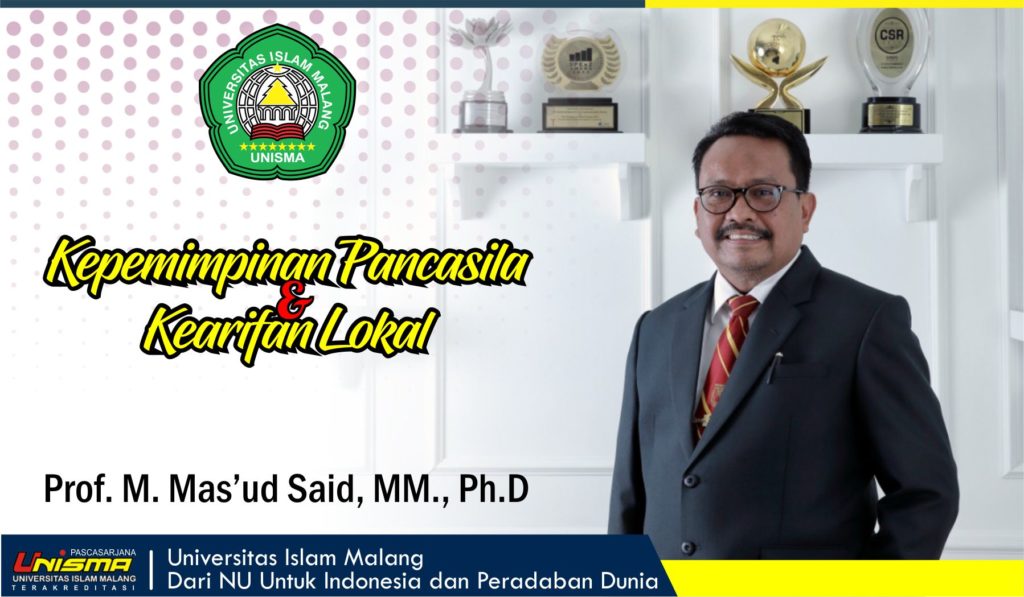
By Prof. M. Mas’ud Said, MM., Ph.D., Director of the Postgraduate Programme, Islamic University of Malang (UNISMA)
