
 Indonesia
James A. Banks: The Prophet of Multiculturalism Research
Any scholar of multicultural education will be well acquainted with the name James A. Banks. This academic and researcher from the University of Washington has been widely crowned as the “Father of Multicultural Education.”
His claim as the first to theorise the concept of multicultural education has further consecrated him as the “prophet” among multiculturalism researchers.
His academic pronouncements frequently adorn the pages of books and journals on the subject. One would be hard-pressed to find a single piece of literature on multicultural education that does not cite his thinking.
As widely known from one of his landmark works, Multicultural Education: Issues and Perspectives, Banks honestly acknowledged that multicultural education was born out of the civil rights movement of the 1960s.
During that decade, African Americans began demanding equal rights in the public sphere equal to those of white Americans. The primary objective of the movement was to eliminate discrimination in public accommodation, housing, employment, and education. Yet, sixty years on, has the United States been freed from ethnic discrimination? The answer is a resounding no.
Banks himself explicitly stated that “multicultural education is opposed to the Western tradition.” In his multicultural education “project,” he did not seek to be anti-Western per se, but rather to oppose a Western tradition that tends toward supremacy — one that regards other ethnicities as castes consigned to a subordinate position.
It is therefore unsurprising that one of the key dimensions of multicultural education as he conceived it is prejudice reduction toward particular racial or ethnic groups. In other words, multicultural education is directed toward equality of standing and the dismantling of racial sentiment. But has this project succeeded in transforming America or, to borrow Banks’ own phrase, in erasing the Western tradition?
Once again, the answer is: no.
The United States and the Problem of Discrimination
From my observations, what is unfolding in the United States today is a time bomb, the product of the failure of “part of” American society, or of the paradigm of its elite, in the way it regards fellow citizens of other backgrounds. The act of Minneapolis police officer Derek Chauvin, who knelt on the neck of Black security guard George Floyd causing him to struggle to breathe and ultimately die was merely a trigger.
Acknowledged or not, the election of Donald Trump as US President whose campaign was littered with racially charged rhetoric also implied that a segment of American society yearned for a leader capable of restoring white supremacy.
Add to this a series of documented cases among them a report by National Geographic Indonesia journalist Rahmad Azhar Hutomo in early 2019 recording that the number of Black drivers pulled over by police far exceeded that of white drivers.
Of the estimated 20 million traffic stops conducted by police in the United States each year, the disproportionate majority of those targeted are Black citizens. Black and Hispanic drivers are searched more frequently than white drivers, despite being no more likely to be carrying contraband.
Such cases point to the enduring strength of white supremacist sentiment. This was further underscored by the events of 11–12 August 2017, when a white supremacist march took place in Charlottesville, Virginia, reigniting America’s long-standing and seemingly eternal racial conflict.
In the rally known as Unite the Right, coordinated by America’s far-right comprising White Supremacists, White Nationalists, Neo-Confederates, Neo-Nazis, and Militia Movements, the march in Charlottesville, often referred to as A12, aimed at unifying white nationalist movements across the United States.
This so-called ultra-right group also views improvements in the political, economic, and social conditions of minority citizens as a threat, and has not hesitated to resort to violence in opposing such developments. In 2015, Dylan Roof, a white man, carried out a terrorist attack at an African American church in Charleston, killing nine Black worshippers. Local communities believe the shooting was racially motivated. The bloodshed in Charlottesville and the Charleston massacre were not the first racial conflicts in the United States and, as has been proven, they were not the last.
What Is the Point I Wish to Make?
Kiai Tholchah Hasan and the Concept of the Roots of Multiculturalism
That to truly understand multiculturalism, one need not travel to another continent.
I am not positioning this as a contest between the contributions of James A. Banks and those of Kiai Tholchah Hasan. In the academic sphere, Banks has made theoretical contributions, yet his work still leaves behind a practice that “merely offers” the aroma of paradise, as his academic writings suggest.
So what of Kiai Tholchah Hasan? He can be described as a kiai of genuine integrity, his knowledge was put into practice, his theory was lived. He was personally dispatched by Gus Dur and played a pivotal role in conducting investigation and reconciliation efforts in the Ambon conflict in the early 2000s. His thinking on multiculturalism is elegantly simple: the capacity to live together with “others.”
While Banks introduced the concept of the dimensions of multicultural education, Kiai Tholchah introduced what he called the roots (akar) of multiculturalism. The choice of the word “roots” is by no means incidental. It is not merely a foundation, but roots: living, dynamic, continuously driving deeper into the ground so that whatever stands above them grows stronger and more steadfast. For Kiai Tholchah, the roots of multiculturalism are: inclusivism (inklusifisme), tolerance; moderatism (moderatisme), tawasuth; harmony (harmoni), tawazun; and contributive-communicative engagement (kontributif-komunikatif), ta’awun-tasyawur.
Put differently, the capacity and willingness to live alongside the other across ethnic, faith, and cultural boundaries cannot possibly be realised without the prior strengthening of these roots of multiculturalism. This is why Kiai Tholchah once offered a sharp critique: that multicultural education frequently proceeds speculatively, because it has entered the wrong room. It is projected merely as “intellectual nourishment,” rather than being directed toward empirical experience.
Kiai Tholchah’s deep familiarity with the Islamic scholarly tradition, combined with his empirical and academic experience as an Indonesian who has lived multiculturalism, makes him entirely deserving of the title Father of Multicultural Islamic Education.
He did not merely conceptualise what multicultural education is through academic writings; he also descended directly into conflict zones, building bridges of peace and “institutionalising” it within an Islamic higher education institution. Viewed through the lens of the hadith sciences, Kiai Tholchah fulfils the criterion of tsiqoh reliable and trustworthy as a reference point for Multicultural Islamic Education.
It is therefore not an overstatement to say that the United States needs to study the thinking of Kiai Tholchah that America needs to look to Indonesia, with its ulama, its kiai, and its community leaders, as a mirror for ending its endless cycle of racial conflict and ethnic discrimination. And not only America the whole world. Look to Indonesia. Look to its kiai and its pesantren.
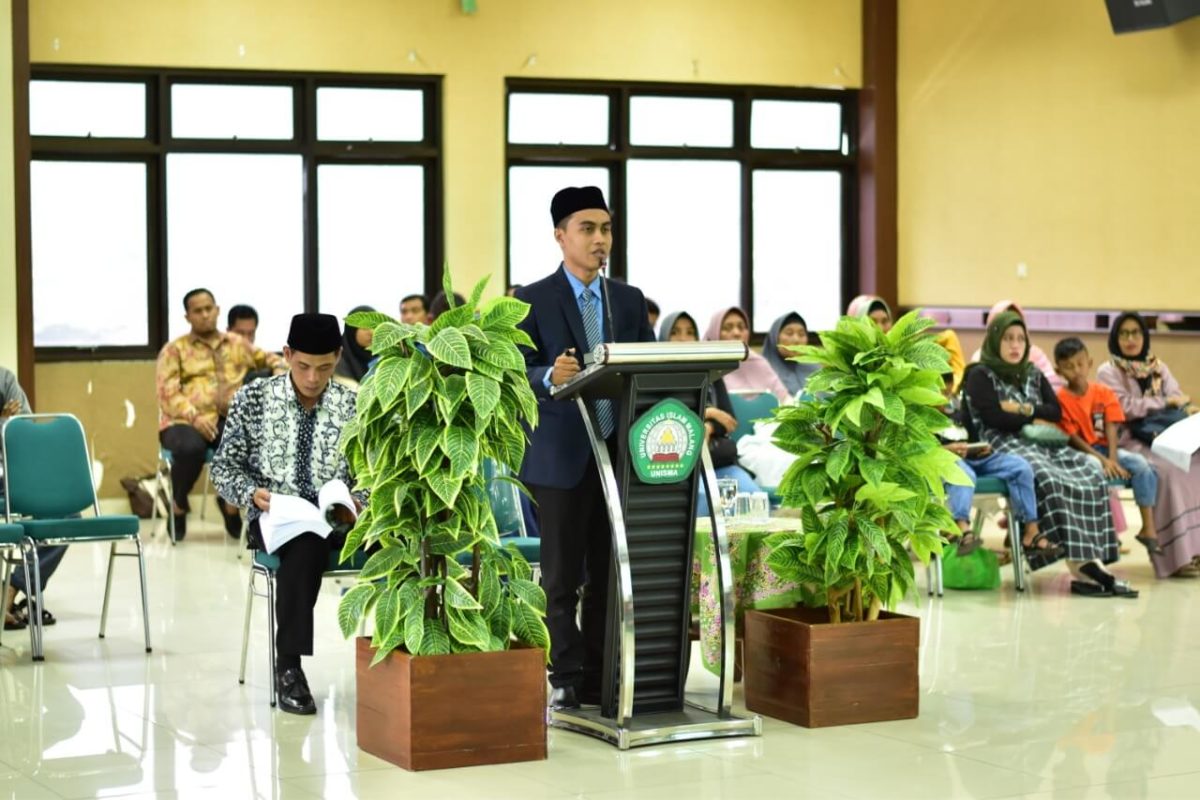
UNISMA, for instance known as a multicultural campus with its Doctoral Concentration in Multicultural Islamic Religious Education is the crystallisation of Kiai Tholchah’s vision of encapsulating the spirit of both Islam and Indonesia.
Through this institution, Kiai Tholchah seemed to aspire to strengthen the “epistemological stance” of succeeding generations, to nurture Indonesia’s diversity through both scholarship and lived experience. We need no longer seek lessons in “living together” from nations that have, in fact, failed to demonstrate success in managing difference.
In the context of managing multiculturality, Indonesia must be made the world’s kiblat. Its point of reference by virtue of its Bhinneka Tunggal Ika (Unity in Diversity) and Pancasila, which in Kiai Tholchah’s own terms constitute a value framework capable of uniting all elements of Indonesia’s multi-ethnic, multi-religious society. If one may be permitted a lighthearted observation: we have even been naturally endowed by God with a moderate, middle-ground complexion, neither black nor white. Strengthened further by our social capital of Pancasila, there is no other conclusion: Indonesia is a lighthouse of world civilisation. ()
By: W. Eka Wahyudi — Lecturer at the Faculty of Islamic Studies (FAI), Universitas Islam Lamongan (Unisla); Alumni of the Doctoral Program in Multicultural Islamic Religious Education (PAI), Universitas Islam Malang (UNISMA)
*) This column is the sole responsibility of its author, and was also published at timesindonesia.co.id
