
 Indonesia
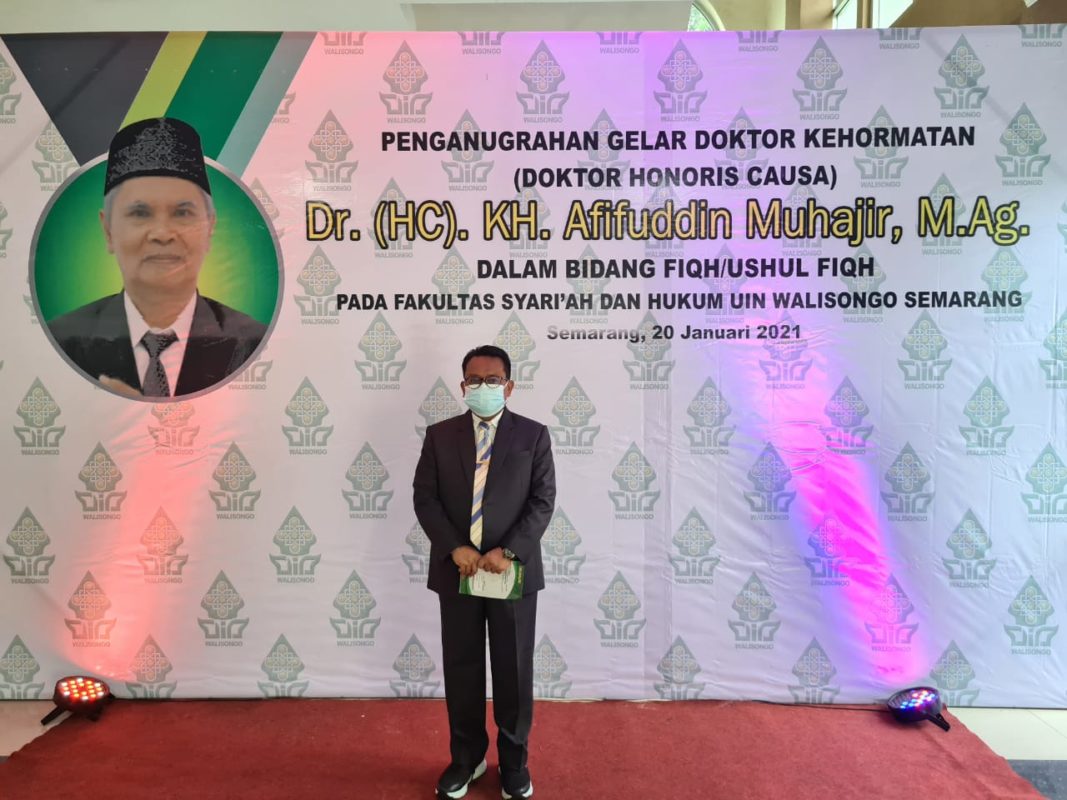
KH. Afifuddin Muhajir, M.Ag, has officially received an honorary doctorate from the Faculty of Sharia at UIN Walisongo Semarang. Among the central arguments in his academic paper, titled “The Unitary State of the Republic of Indonesia in the Scales of Sharia,” is the assertion that Pancasila does not stand in the way of Islamic law.
The senate session conferring the honorary degree was held on Wednesday, January 20, 2021. Attendees included the university’s Rector and its professors, as well as guests from Salafiyah Syafi’iyah Islamic Boarding School, KH. Azaim Ibrahimi and Gus Taj Jasin along with the Secretary General of the Ministry of Religious Affairs, representatives from various universities, and the Chairman of Tanfidz and Rois Syuriah of NU Central Java’s regional board.
Also present was Prof. M. Mas’ud Said, MM., PhD, Director of Unisma’s Postgraduate Program, who offered several key reflections on the occasion.
Read also: Indonesia’s First Sarong-Clad Dissertation Defense
First, he noted, Kyai Afifuddin Muhajir’s position carries real significance for strengthening the unitary state within the framework of Ushul Fiqh (Islamic legal theory), helping ensure the country’s entire governance structure receives a thorough and coherent explanation.
That significance extends to easing unnecessary tension among those who still claim the country is un-Islamic and therefore its laws needn’t be followed. His work clarifies, for all parties, that Pancasila stands as final for Indonesia, its five principles are fundamentally Islamic, entirely consistent with Islamic teaching, and in fact deeply aligned with it.
Second, the depth of this address from a respected NU scholar reinforces the standing of the Indonesian state and government within both Indonesian and global Islamic thought, particularly given that Pancasila itself emerged through the nation’s collective consensus.
Third, Pancasila is inherently Sharia-compliant by its very nature, encompassing principles of belief in one God, humanity and justice, unity, deliberative democracy, and social justice values that align closely with Islamic teaching, both philosophically and in Islamic jurisprudence.
Fourth, Pancasila poses no obstacle (mani’) whatsoever to implementing the Islamic law embedded within it.
Professors from UIN Walisongo Semarang offered warm introductions and praise throughout the event. UIN Walisongo Rector Prof. Dr. K.H. Imam Taufiq, M.Ag, remarked that no one doubts Kyai Afifuddin Muhajir’s scholarly standing, both nationally and internationally.
Kyai Afifuddin holds considerable intellectual authority among Nahdliyin circles, respected even among senior clerics at PB NU and MUI, and has taught scholars integrated approaches to Islamic concepts that avoid fragmentation insisting that genuine understanding requires strong command of both Arabic and the Qur’an. (MMS/AL/PPS)
