
 Indonesia
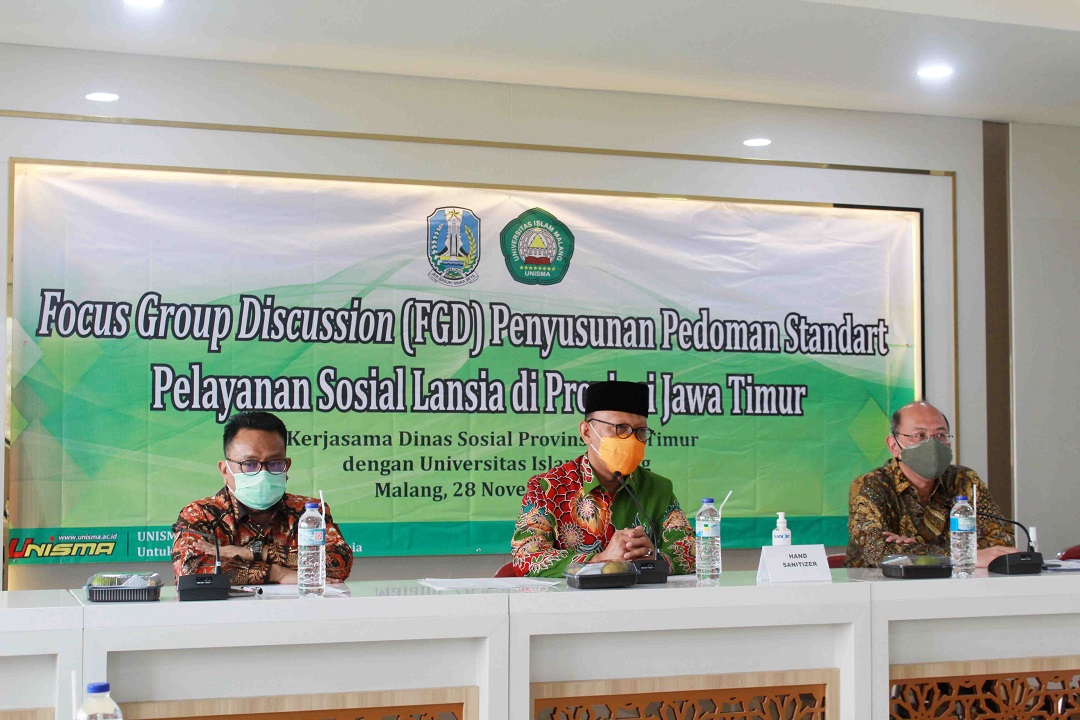
Universitas Islam Malang’s Institute for Research and Community Service, together with East Java’s Provincial Social Affairs Office, has drafted a set of standardized guidelines for elderly care services across the province. The initiative, developed through a Focus Group Discussion, took place at the East Java Studies Center room, 3rd floor, Ali bin Abi Tholib Building, on Saturday, November 28, 2020.
Dr. Bobby Sumiarsono, SH., M.Si, Acting Head of East Java’s Bappeda, opened the session by emphasizing the importance of establishing standardized social service guidelines for the elderly.
Read also: Postgraduate Director Delivers Remarks at the 2020 Millennial Festival
According to Unisma’s Rector, elderly citizens require special attention. Social services for the elderly, he noted, shouldn’t fall solely to institutions; the broader public needs to be equipped and informed so families can care for their own elderly members at home.
The Rector pointed to Japan’s best practices in elderly care, noting how they’re reinforced by a culture that genuinely values and looks after its older generation. He then formally opened the FGD.
Budgeting Policy from East Java’s Acting Bappeda Head
Planning begins with the Regional Medium-Term Development Plan (RPJMD), derived from the Regional Long-Term Development Plan (RPJP), and is grounded in the East Java Governor’s 2018–2023 Vision and Mission, which includes protecting vulnerable groups.
The elderly, particularly those living in poverty, count among those vulnerable groups, and the government must step in to support them. Sumiarsono, a Universitas Gadjah Mada alumnus, recounted the story of a former vice president who expressed regret over the lack of proper standard operating procedures for post-service care.
By 2020, Indonesia’s elderly population was projected to reach 5.38 million out of 39.89 million residents, roughly 13 percent of the total population. While certain regencies host the largest elderly populations overall, service priorities remain focused on those who are poor and vulnerable, with Lumajang Regency recording the highest numbers in that category.
East Java’s elderly care challenges extend well beyond the Social Affairs Office’s own scope, touching several other sectors:
- Healthcare
- Elderly-friendly public facilities
- Neglected elderly individuals
- Elderly citizens below the poverty line
- Basic needs and age classification standards for elderly status
- Limited programs supporting the elderly
Elderly Care Strategy
- Social assistance for poor and vulnerable elderly individuals
- Health insurance coverage
- Optimized care services within elderly care institutions
- Regency and city-level coordination to improve elderly quality of life
- Social guidance programs to build independence
- Accessible, elderly-friendly public facilities
- Dedicated health services for the elderly
East Java’s 2021 draft regional budget (APBD) has already allocated roughly 7 trillion rupiah, about 7 percent of total spending, for social programs. That funding will support the Social Affairs Office’s priority initiatives: 1) PKH Plus, aimed at reducing social welfare problems (PMKS); 2) Allowances for independence movement veterans; 3) The Empowered Disaster-Ready Village (KSB) program.
Strengthening Institutional Capacity for Elderly Care
Prof. M. Mas’ud Said, PhD, Professor of Government Studies, offered insight into strengthening institutional frameworks for elderly care, identifying seven core issues that require reinforcement.
These include legislation, ministerial and regional-level policy, program accessibility, the role of technical implementation units (UPT) and elderly care specialists, regional UPT management, funding sources, and support systems for elderly citizens’ families and communities.
The Unisma Postgraduate Director also stressed the importance of cultivating a genuinely happy environment for the elderly. “Make them feel valued and content,” he said.
East Java’s Elderly Care Strategy
Elderly care cannot be addressed in isolated fragments; it demands coordinated effort across every level of government. Specifically for East Java, Bappeda Head Bobby Soemiarsono outlined seven core strategies.
First, social assistance for poor and vulnerable elderly individuals. Second, health insurance coverage for both groups. Third, optimizing care services within elderly institutions. Fourth, strengthening coordination with regencies and cities across East Java. Fifth, social guidance programs. Sixth, ensuring accessible, elderly-friendly public facilities. Seventh, dedicated health services for the elderly.
In East Java, there are 5,376,672 elderly people, with 2,345,388 of them classified as low-income and vulnerable (AL/Nad/PPS).
