
 Indonesia
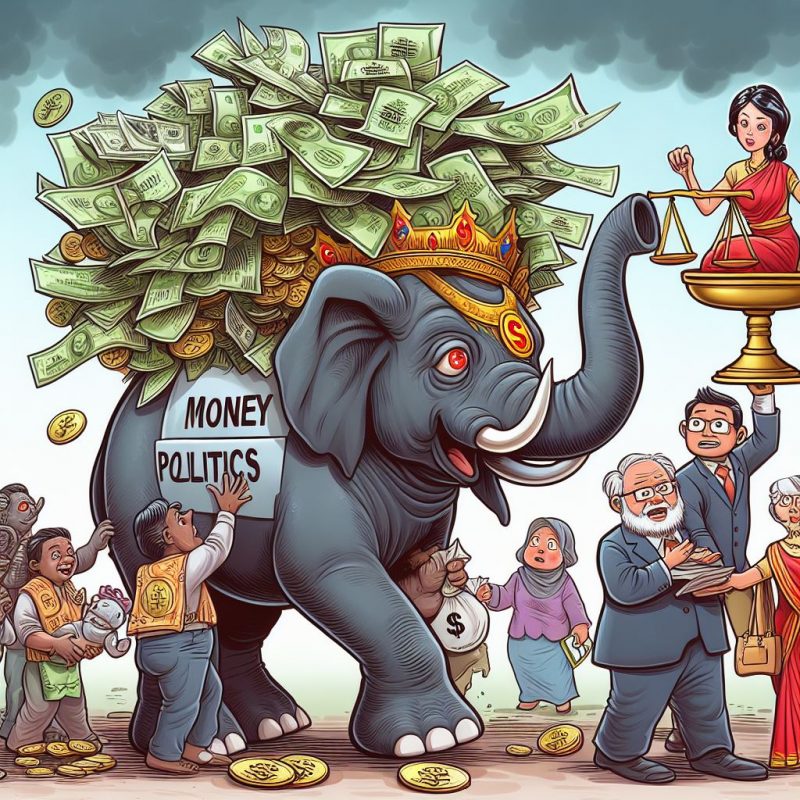
Indonesian democracy is being tested by rampant money politics. People’s voices, which should determine the nation’s direction, have been sold for rupiah bills. When people’s representatives are elected through these corrupt practices, can they truly work for people? Or do they instead become puppets of the oligarchy and rent-seekers?
Money politics traps people in a vicious cycle. Candidates are elected not because of their capabilities and vision, but because of thickness of their wallets. Instead of fighting for public aspirations, they are bound to interests of the oligarchs who fund their campaigns.
People are silenced with the lure of small change, while the nation’s fate hangs in the balance. Policies are made not for the people’s welfare, but to appease the tycoons and their cronies. The people’s voices are buried, replaced by the clatter of rupiah speaking.
This is because money politics undermines the principles of a healthy democracy. In an ideal democratic system, the election of leaders should be based on capability, vision, and commitment to the people’s interests. However, when money politics becomes the determining factor, candidates with substantial financial resources have an advantage in securing victory, even if they lack the necessary qualifications or integrity. Consequently, democracy that is supposed to represent the people’s voice becomes distorted by financial interests.
Furthermore, this is also because the practice of political corruption tends to strengthen the power of political oligarchy. This oligarchy consists of a handful of individuals or groups who control significant economic resources. Those who finance political campaigns are often part of this oligarchy. Consequently, elected candidates are more likely to be bound by the interests and agendas of oligarchs who finance their campaigns than to champion people’s aspirations as a whole. This results in unequal political representation, where voices of the majority are ignored in favor of narrow interests of the elite groups funding the campaigns.
Read also: “The Rhyme-Maker”: A Reflection on the Chaos of Local Election Politics
Multiculturalism Threatened, Justice Compromised
Money politics widens the gap of inequality and discrimination. In money politics, financial power becomes the dominant factor determining the extent of a group’s or individual’s influence in the political process. Minority groups with limited financial access will struggle to compete with more affluent groups. Thus, financial inequality directly mirrors political inequality. Consequently, the aspirations and interests of these minority groups tend to be overlooked due to a lack of resources to advocate for them.
In a political system also dominated by money, the voices of minority groups are often marginalized due to a lack of financial resources to gain access and advocate for their interests. Political money practices, such as vote-buying or expensive political campaign financing, can lead to the voices of minority groups being sidelined or even silenced entirely. This results in disproportionate political representation and raises concerns that the aspirations and needs of minority groups are not adequately addressed in the political decision-making process.
The concept of multiculturalism, which upholds diversity and equality, is under threat. The practice of money politics can reinforce inequality in society by giving an advantage to those who have sufficient financial resources to engage in money politics. This can result in certain groups or wealthy individuals becoming more powerful and dominating the political arena compared to groups or individuals who are less financially capable. Consequently, the principle of equality within multiculturalism can be eroded due to unequal access to political influence.
Read also: False Loyalty: Behind the Smiles of Politicians’ Campaign Teams and Money Politics
The practice of money politics can also lead to homogenization or a reduction in the diversity of representation within political institutions. When candidates or political parties that receive large sums of money have a financial advantage in campaigns, this can prevent candidates or groups representing cultural diversity or different viewpoints from gaining sufficient representation in government. Consequently, the representation of various cultural or ethnic groups in political institutions may become limited, which contradicts the principle of multiculturalism that values diversity.
Author: Imam Alfafan Yakub
