
 Indonesia
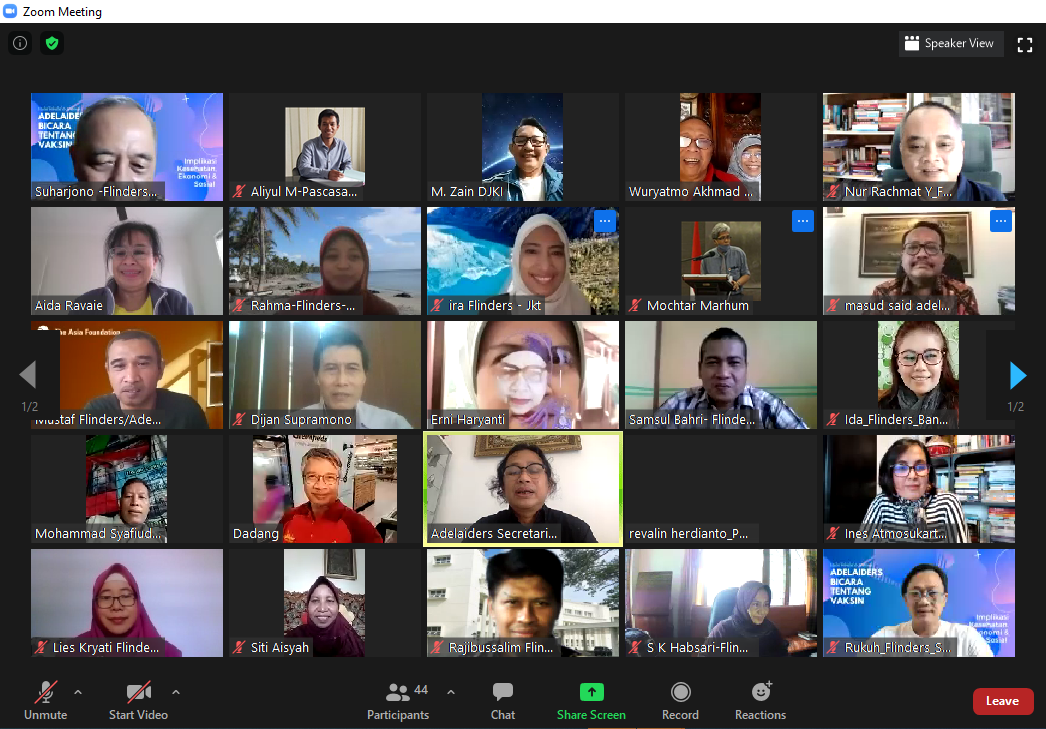
June 12, 2021 – Prof. Mas’ud Said, Director of Unisma’s Postgraduate Program, presented on the social impact of COVID-19 vaccination during a halal bihalal event and webinar held with alumni who studied in Adelaide, South Australia.
The webinar, titled “Adelaiders Talk Vaccines: Health, Economic, and Social Implications,” ran for two and a half hours, moderated by Diza Alia, MBA, an alumna of the University of South Australia, and Dedi Saputra, MPPM, an alumnus of Flinders University.
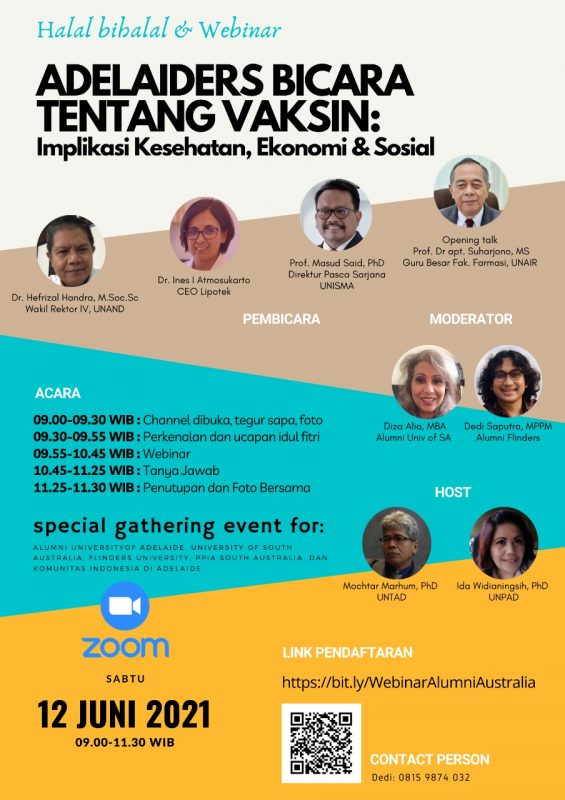
Poster for the “Adelaiders Talk Vaccines: Health, Economic, and Social Implications” discussion
Prof. Mas’ud Said spoke as the second presenter, following an opening address by Prof. Dr. apt. Suharjono, MS, Professor of Pharmacy at Universitas Airlangga. He explained that East Java’s total vaccination target stands at 22,914,568 people, with three vulnerable groups currently prioritized: healthcare workers, public service officers, and the elderly.
The combined target for these vulnerable groups totals 4,120,114 individuals. Of that group, 33.15 percent have received their second dose, while 74.19 percent have received their first.
Read also: Prof. M. Mas’ud Said, PhD, Motivates FIA Graduates to Pursue Further Studies
The Flinders University doctoral alumnus identified at least five notable social shifts resulting from vaccination efforts:
- A shift from loose, uncontrolled crowding in social and religious gatherings toward greater physical distancing.
- A shift from fear of leaving home toward renewed confidence in working and engaging in daily activities.
- A shift in social norms around handshakes and hand-kissing as markers of politeness, now regarded more loosely, and increasingly in reverse.
- A shift from viewing large crowds as a measure of an event’s success toward embracing virtual formats instead.
- A broader shift from in-person to online interaction, from wastefulness toward greater efficiency, and from time-consuming processes toward genuine simplicity, all driven by technology.
Read also: Prof. Mas’ud Said, PhD, Addresses Bureaucratic Reform at the Vice President’s Secretariat
Dr. Ines Atmosukarto, CEO of Lipotek, discussed several vaccine variants, noting that certain formulations, such as the Pfizer vaccine used in the United States and Israel, have successfully reduced patient hospitalization rates, easing pressure on healthcare workers managing patient care.
Hefrizal Handra, M.Sos.Sc, Deputy Rector IV of Universitas Andalas, addressed the pandemic’s broader impact on both Indonesia’s national economy and the global economy.
