
 Indonesia
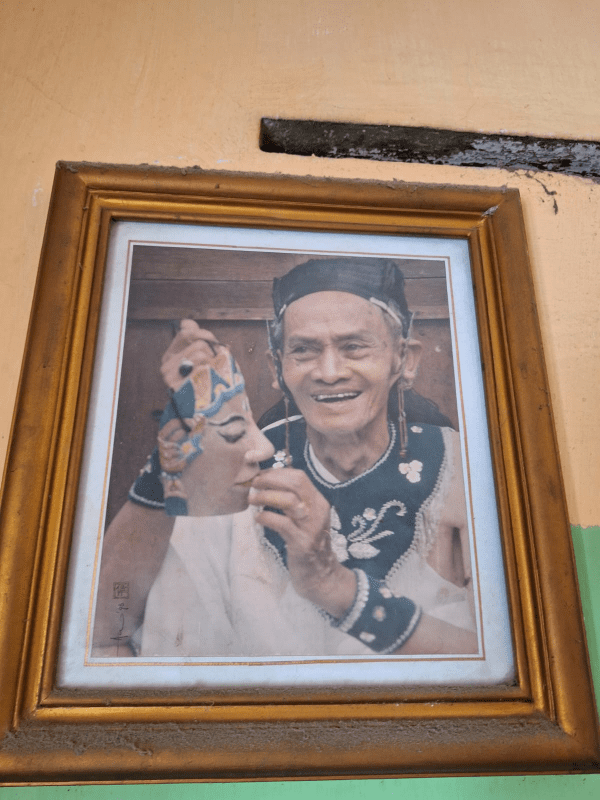
The legendary figure of Mask Dance who became widely known across parts of East Java, Indonesia, was born in a hamlet called Glagahdowo, Pulungdowo Village, Tumpang District, Malang Regency. Born Rasimun on June 15, 1932, he devoted his life to the art of the Gunungsari mask dance. His artistic journey began in 1939 when, at the young age of eight, he entered the world of Malangan mask dance.
During his youth, Rasimun married the woman he loved, Patonah, and they built a household that lasted for 73 years. Although the couple had no biological children, they adopted a son named Slamet Muchsin, whom they supported through higher education. After graduating from Tumpang State Senior High School with a science major, Slamet pursued his undergraduate studies at the Faculty of Administrative Sciences at Universitas Islam Malang. He later completed both his master’s and doctoral degrees at the Faculty of Administrative Sciences of Universitas Brawijaya. Since 1989, Slamet has served as a permanent lecturer at the Faculty of Administrative Sciences of Universitas Islam Malang, holding the rank of Associate Professor and currently serving as Head of the Master’s Program in Public Administration. He is now in the process of applying for a professorship at the university.
Artistic Journey
Between 1949 and 1976, Rasimun was also active in the traditional theatrical art of ludruk, performing roles such as Pengremo Beskalan and Pawestran. He also performed as a dancer in Beskalan Putri Malangan, Remo Putri, Mask Dance, and Jangger. During his teenage years, he joined several ludruk troupes, including Sinar Muda, Margo Utomo, Sagri, Marhaen, and Nusantara.
Thanks to his remarkable talent and mastery, he also taught at the “Seni Mangundharma” art hermitage in Tulus Besar Village, Tumpang District. The studio was led by the renowned academic and legendary multi-talented dancer M. Soleh Adi Pramono, widely known as Ki Soleh Adi Pramono. The Mangun Dharma Art Hermitage remains one of the traditional art centers that continues to thrive in Malang Regency. It was founded on August 26, 1989, by Ki Soleh Adi Pramono with support from the Malang local government.
The name Mangun Dharma was derived from the street where the hermitage stands Mangun Dharma Street. Historically, the name refers to a Senopati who lived during the reign of Sultan Agung and was assigned to guard Mount Buring in the Bumiayu area of Malang. The adoption of the name Mangun Dharma was also an effort by local residents and Ki Soleh Adi Pramono to preserve its historical significance.
The Legacy and Achievements of Mbah Rasimun
One of Mbah Rasimun’s greatest contributions was saving the Malangan Mask Dance tradition from the brink of extinction. Through his dedication, he preserved and passed on this art form to the surrounding community. His dance style became widely recognized for its refined Gunungsari characteristics.
A memorable moment occurred in 1984 when the Surabaya Arts Council organized a Malangan Mask Dance performance and discussion at the Youth Hall in Surabaya. On that occasion, Mbah Rasimun demonstrated his extraordinary skill as a Glagahdowo mask dancer, delivering a unique and captivating performance that deeply impressed the audience.
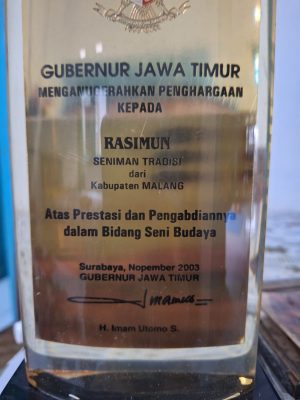
Traditional Arts Appreciation Plaque Presented to Mbah Rasimun
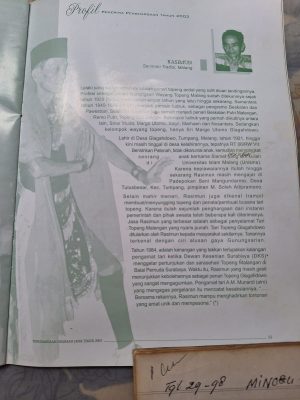
East Java Artist Appreciation Magazine Honoring Mbah Rasimun
Throughout his career, Rasimun received numerous awards and recognitions, including:
- Award from the Ministry of Education and Culture through the State Indonesian Karawitan High School (SMKI) in Surabaya in 1987
- Award from the East Java Provincial Government’s Department of Education and Culture for his contribution to the East Java Arts Festival in 1988
- Third Prize in the Bapang Dance Competition from the Kanjuruhan Art Studio in 1990
- Appreciation from SMKI for his participation in the Wayang Pinggiran Creative Forum in 1994
- Award from the PSDM Arts Council at the Tumpang Craft Exhibition in 1991
- Recognition from the V/Brawijaya Regional Military Command for participation in the 51st anniversary of the Indonesian Armed Forces in 1997
- Award from the Malang Arts Council for participation in the Kidungan 2 Art and Craft Exhibition in Malang in 1989
- Appreciation from Satya Widya Tourism Academy Surabaya during a seminar and performance of Malang Mask Puppet Theatre in 1997
- Award from the Malang Arts Council and Mangun Dharma Art Hermitage for his active role as a resource person in 2000
- Recognition from IPK Nadya Laksita Yogyakarta as a speaker and instructor of Beskalan Putri Malangan dance in 2021
- Cultural Achievement Award from the Governor of East Java for his dedication to arts and culture in 2003
These achievements reflect his lifelong dedication to the development and preservation of traditional dance in Indonesia.
Paguyuban Margo Utomo
In his efforts to further develop Malangan Mask Dance, Rasimun and his colleagues established the “Wayang Topeng Sri Margo Utomo” community in his hometown. The group was chaired by Ruslin, while Mbah Rasimun also once served as its leader. Throughout his career, Rasimun dedicated himself as a trainer of mask puppet performances and as a skilled mask sculptor.
His expertise in carving and decorating masks, as well as designing traditional mask dance costumes, was widely recognized. Because of this, he received numerous awards from both government institutions and private organizations.
The Sri Margo Utomo community has also become a training and internship destination for several universities, including Universitas Negeri Malang, Institut Seni Indonesia Yogyakarta, and Universitas Negeri Surabaya, as well as regional arts councils. These institutions frequently sent dancers to learn directly from Mbah Rasimun and deepen their understanding of mask dance and other traditional cultural dances. Visitors to the community have come not only from within Indonesia but also from abroad, including the United States.
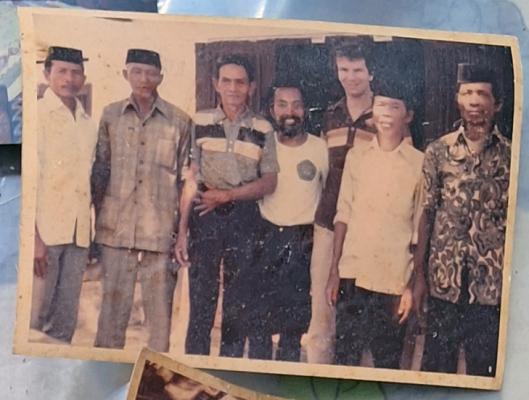
Standing third from the left are Mbah Rasimun, Ki Soleh Adi Pramono, and Dr. Andy Sutton from the University of Wisconsin together with the founders of the Margo Utomo community.
The development of traditional arts such as Mask Dance cannot be separated from the collaboration between art and knowledge. Mbah Rasimun was inspired by personal experience and self-taught learning, as well as guidance from communities devoted to Malangan mask art. The presence of Ki Soleh Adi Pramono, an academic deeply engaged in both traditional and modern arts, further enriched the collaboration between artistic practice and academic knowledge, strengthening the development of Mask Dance.
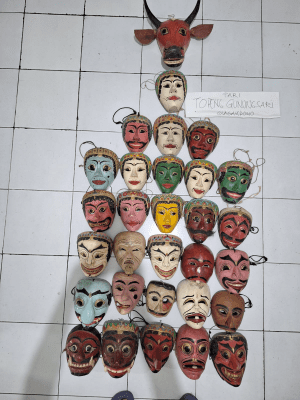
Mbah Rasimun’s Mask Artwork
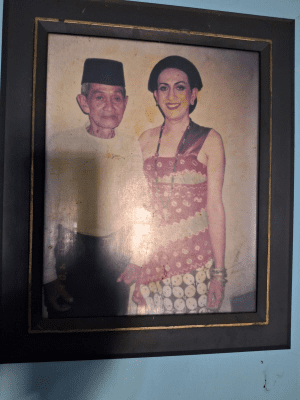
Didik Nini Towok with Mbah Rasimun
The Sri Margo Utomo Wayang Topeng community also welcomed a prominent guest, the versatile dance maestro Didik Nini Towok. The maestro himself once learned Mask Dance directly from Mbah Rasimun. His visit enriched the community’s artistic experience, and he also contributed to the development of the group and supported Mbah Rasimun’s work.
Closing
Remembering the golden era, achievements, and role of the guardians of Malangan Mask Dance is essential. During its peak, this dance tradition flourished with distinctive character and uniqueness. The preservation of this tradition serves as a living testament to the dedication of those who worked tirelessly to sustain it.
In 2004, Mbah Rasimun passed away, leaving behind lasting memories and a rich legacy of Malangan Mask Dance. The tradition in Glagahdowo continues through the Grebeg Jawa Mask Dance, which preserves the Gunungsari style. The Setyotomo Art Studio led by Mr. Utomo continues to educate and preserve this cultural heritage, ensuring that future generations will carry forward the legacy of Malangan Mask Dance.
Author: Slamet Muchsin
Editor: Aliyul Murtadlo
