
 Indonesia

On Thursday, July 24, 2025 – Director of the UNISMA Postgraduate School, Prof. M. Mas’ud Said, MM., Ph.D., attended the inauguration ceremony of Prof. Dr. Nur Rachmat Yuliantoro, a former classmate during his studies at Flinders University, Australia.
Prof. Mas’ud Said is an alumnus of Flinders University in Social Sciences, while at the same time Nur Rachmat Yuliantoro pursued a Master of Arts in International Studies at the same institution. He later completed his doctoral program in Asian Studies at Flinders University.
Prof. Dr. Nur Rachmat Yuliantoro was officially inaugurated as Professor at the Faculty of Social and Political Sciences (FISIP), International Relations Study Program, with a specialization in International Development Studies in East Asia.
Prof. Mas’ud Said highlighted key points from the inaugural speech titled “Debt Trap Issues in Financing China’s Belt and Road Initiative (BRI) Projects in Indonesia: An Open Study on Complexity and Challenges.”
In his address, Prof. Nur Rachmat Yuliantoro challenged the argument advanced by Indian academic Brahma Chellaney, who described Indonesia’s large debt to China as a “debt trap.” Similar concerns were echoed by former US Secretary of State Rex Tillerson, who referred to China as a “predatory lender.”
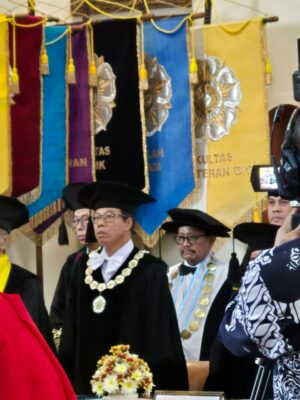
Prof. Mas’ud attending the inauguration ceremony of Prof. Nur Rachmat Yuliantoro
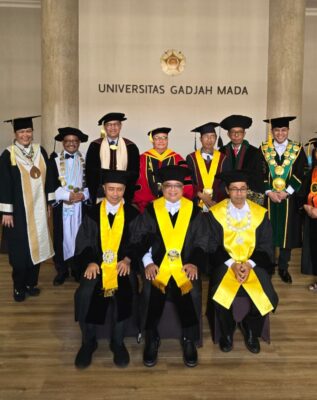
Prof. Mas’ud and Prof. Rachmat with professors from various domestic and international universities
Prof. Dr. Nur Rachmat Yuliantoro illustrated his argument by comparing Indonesia’s debt-financed Jakarta–Bandung high-speed railway (WOOSH) project with Sri Lanka’s experience in funding ports, airports, toll roads, and power plants. When the Sri Lankan government struggled to repay its debts, control of strategic assets eventually shifted to China.
Contrary to common assumptions, Prof. Nur Rachmat Yuliantoro asserted that Indonesia’s position differs from Sri Lanka’s case. Nevertheless, he urged the Indonesian government to remain prudent and carefully assess risks if similar projects are expanded excessively, as overexposure could weaken national resilience and create unhealthy dependency in the long term.
Read also: Scientific Publication Workshop for Students
