
 Indonesia
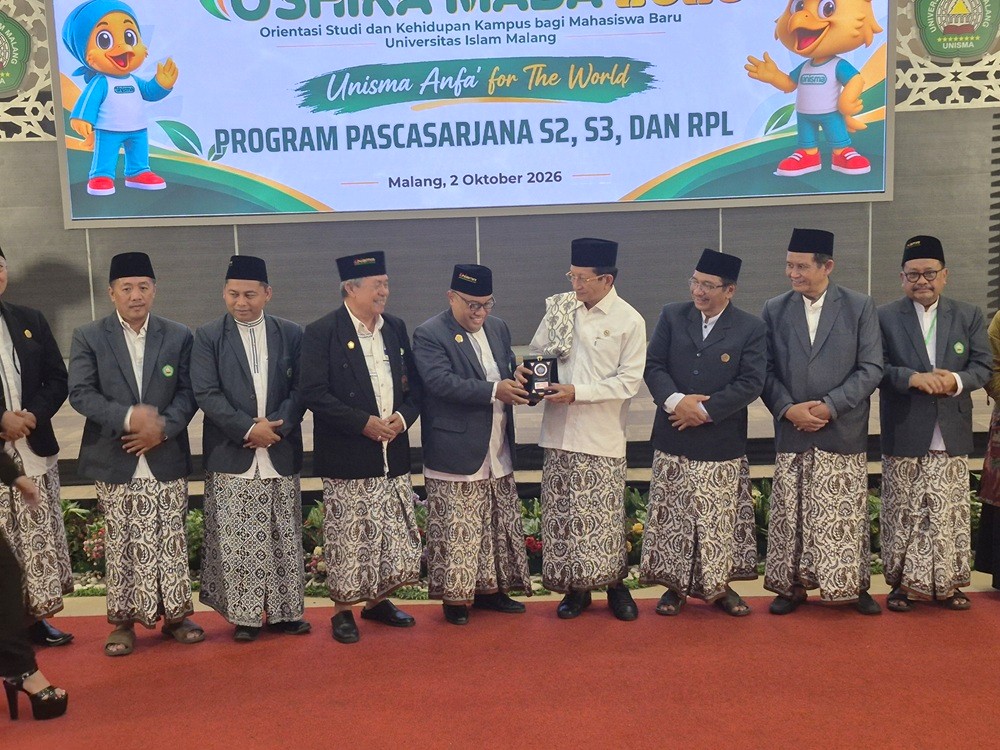
New Student Orientation (Oshika Maba) 2026 of the Postgraduate Program at Universitas Islam Malang (UNISMA) became a moment to strengthen academic orientation and the values students should carry throughout their studies, held Friday, October 2, 2026, at Unisma’s Postgraduate Building. Themed “Anfa’ for the World,” the event brought together master’s, doctoral, and Prior Learning Recognition (RPL) students.
Unisma Rector Prof. Drs. Junaidi Mistar, PhD, said the Minister of Religious Affairs’ presence during Postgraduate orientation offered meaningful encouragement for new students. One message he emphasized was the importance of setting genuine intent before beginning one’s academic journey.
“He hoped students would set the right intent for studying at Unisma,” Junaidi said on Friday.
He noted that message ties directly to Unisma’s history as a university founded by respected Islamic scholars. Studying at Unisma, he explained, was never meant solely as a path toward knowledge and academic credentials.
“Unisma stands as an institution founded by Ulama. So it’s not just about pursuing knowledge, there’s blessing in it too,” he said.
Junaidi added that the Minister also reminded students to broaden how they understand the word “teacher.” Within a university rooted in Nahdlatul Ulama tradition, learning extends beyond interaction with lecturers in the classroom.
“A teacher isn’t only someone present in class, Unisma’s founders themselves can serve as teachers too. Learning from their spirit, their knowledge,” he said.
He pointed to the late Prof. KH Tolchah Hasan as one such figure, a central name in Unisma’s history.
Organizers hope this encouragement will serve as a foundation for new Postgraduate students, who come from diverse academic and professional backgrounds.
“Insyaallah, with this encouragement, Unisma’s Postgraduate students across bachelor’s, master’s, and prior learning recognition programs now carry clearer intent,” Junaidi said.
Unisma is also currently processing several new study programs at the postgraduate level. Three programs reportedly in development include a Doctoral Program in Government Studies, a Doctoral Program in English Language Education, and a Master’s in Accounting.
This year’s Oshika Maba Postgraduate orientation recorded a total of 810 students. Not all attended in person on campus, however, since RPL students joined the event online.
“Total enrollment reached 810. Mainly RPL students joined online. Those attending in person are our master’s and doctoral students,” Junaidi said.
RPL students carry distinct characteristics, since most already hold jobs, a factor that shaped how the new student orientation was structured.
Junaidi explained that the event, originally scheduled for Saturday, was moved up to Friday to accommodate the Minister of Religious Affairs’ schedule.
Meanwhile, Unisma Postgraduate Director Prof. H. M. Mas’ud Said, MM., PhD, equipped new students with several key points to keep in mind from the very start of their studies.
He placed time management at the center of successfully completing postgraduate education. Students, he said, must learn to balance coursework, assignments, field research, and the demands of writing a thesis or dissertation.
“Time management, managing coursework, finishing assignments, field research, thesis, dissertation, that’s the key to success,” Mas’ud Said said.
He reminded students not to treat academic ability as the sole measure of success, noting that every postgraduate student carries their own capacity, one that simply needs to be managed well.
“No one here lacks intelligence, everyone has something impressive to offer,” he said.
Mas’ud also urged students to stay on top of administrative and financial matters throughout their studies, noting that administrative discipline plays a critical role in preventing technical setbacks from disrupting the learning process.
“Secure your administration and finances. Administrative discipline is key to a successful academic journey,” he said.
His next piece of advice centered on self enrichment. Students, he said, shouldn’t stop at material delivered in lectures alone, but should actively follow academic developments through books, journals, scholarly updates, and their lecturers’ published work.
He even encouraged students to familiarize themselves with each lecturer’s academic output.
“Treat every lecturer like one big file,” he said.
Students, he continued, can trace a lecturer’s scholarly work, understand their area of expertise, and eventually draw on those references to strengthen their own thesis or dissertation research.
“Search up Prof. Nurhayati right away, see what she’s published, then cite it later in your thesis,” he said, offering an example.
The same advice applies across other fields of study. Students are encouraged to follow their lecturers’ ongoing research and treat the academic environment itself as a source of intellectual enrichment.
Mas’ud also stressed the importance of staying informed about campus updates. Postgraduate students, he said, need to actively monitor announcements from their study programs and academic information to avoid missing important matters throughout their studies.
“No one is truly capable unless they’re also good at seeking out information about coursework and announcements from their program,” he said.
He reiterated all four points, time management, administrative and financial discipline, self enrichment, and staying informed on campus matters, as priorities students should carry with them from the very start of their studies.
This article was originally published on JatimTIMES.com under the title “Oshika Maba Pascasarjana Unisma, Rektor Tekankan Niat Kuliah dan Keteladanan Ulama.”
