

Sweden’s recent decision to reverse course and return to offline education has reignited a long standing debate: is offline learning genuinely more effective than online learning, or has that assumption gone unquestioned for too long? The answer, as with most questions in education, resists easy generalization.
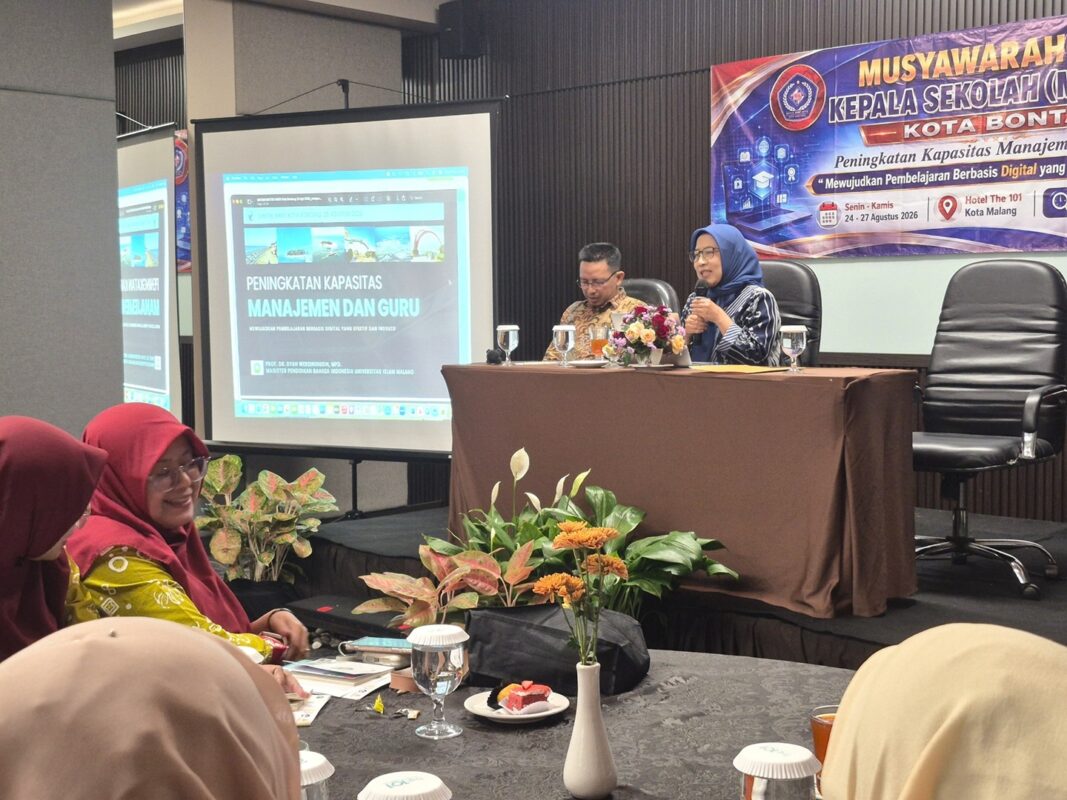
That very question surfaced during an MKKS Bontang City workshop held in Malang, posed directly to Prof. Dyah Werdiningsih, M.Pd., a professor of Indonesian language education at Universitas Islam Malang.
“Technology in education is merely a tool. Success in education depends heavily on content and teaching methods,” she said, drawing on years of experience as an education assessor.
“Technology is just a tool, much like a knife. In a chef’s hands, a knife creates a delicious meal. In the hands of a criminal, it can take a life,” Prof. Dyah added.
Online vs. Offline Learning: What Sets Them Apart?
Online learning relies on internet connectivity, while offline learning proceeds independently of network access and typically involves face to face interaction. That fundamental difference produces distinct learning experiences for students.
Online learning allows teachers and students to interact through devices such as computers or smartphones, with material delivered through learning platforms, videos, virtual conferences, and other digital resources.
Offline learning, by contrast, places direct interaction at the center of the learning process. Teachers and students share the same physical space, enabling real time discussion, hands on practice, observation, and guidance.
Neither method is inherently superior. Each proves most effective within its own context and conflating the two, or treating one as a universal solution, misrepresents how learning actually works.
Does Online Learning Have the Edge?
Online learning holds a clear advantage in flexibility and accessibility, but that advantage depends heavily on technological readiness and a student’s capacity for independent study.
Flexibility is online learning’s chief strength. Students can access material from different locations without needing to be physically present at school, a quality that gives online learning real potential to expand educational access.
Indonesia’s Ministry of Primary and Secondary Education identified Distance Learning (PJJ) in 2026 as one strategy for expanding more inclusive and equitable access to education. The country’s geography, an archipelago spanning more than 17,000 islands, underscores the need for adaptive education delivery models.
Online learning also lets teachers draw on a wide range of digital resources: videos, simulations, interactive quizzes, and electronic materials that enrich the learning experience.
Flexibility, however, does not automatically translate into effective learning. A systematic literature review of online learning in Indonesia found that limited infrastructure and inadequate technological readiness remain significant barriers to its effectiveness.
Does Offline Learning Have the Edge?
Offline learning proves superior when the learning process demands direct interaction, teacher guidance, hands on practice, or face to face communication.
In a physical classroom, teachers can observe student responses in real time. When students appear to struggle with the material, teachers can immediately step in with further explanation or adjust their teaching approach.
Direct interaction also creates more room for discussion, group work, hands on practice, and activities requiring physical tools or environments.
Research conducted at MA Al Amin Tabanan found offline learning more effective than online learning based on indicators including teaching quality, appropriateness of instructional level, incentives, and use of learning time.
A separate study at SMP Negeri 3 Pleret reported that 69.2 percent of surveyed students considered offline learning more effective, a view shared by 62 percent of teachers. These figures cannot be generalized across all schools, but they indicate that face to face learning remains highly valued by a significant share of students and educators alike.
What Risks Come with Online Education?
The greatest risks associated with online education are unequal access, diminished social interaction, and inconsistent learning quality.
Not every student has equal access to devices, internet connectivity, a conducive learning environment, or family support. As a result, a method that appears flexible for some students can become a genuine obstacle for others.
UNESCO has warned that education’s digital transformation carries several risks, including widening learning inequality, student isolation, privacy concerns, and diminished public oversight of the educational process.
Learning quality presents another challenge. UNESCO notes that online learning faces quality concerns, since not every digital learning program receives adequate evaluation and oversight.
Simply moving classroom activities onto a screen, then, is not enough. Teachers still need sound instructional design, deliberate interaction, proper evaluation, and adequate technological support.
Read also: Lessons on Patience and Perseverance
What Are the Weaknesses of Offline Learning?
Offline learning’s primary weakness lies in its lack of flexibility, requiring physical presence, fixed timing, specific locations, and dedicated facilities.
Students must show up at the designated learning site according to a fixed schedule, a pattern that can prove impractical for those living far from school or facing certain limitations.
Offline learning also runs into difficulty when geography or particular circumstances make in person meetings hard to arrange. Given Indonesia’s vast and scattered territory, online learning continues to serve an important function in broadening educational access.
Moreover, not every offline learning activity is automatically effective. The mere presence of teachers and students in a classroom does not guarantee active engagement, genuine understanding, or achievement of learning objectives.
In other words, the real issue is not simply online versus offline, but how the learning experience itself is designed and delivered.
So, Which Is Truly Better: Online or Offline Learning?
No single method works best for every situation. The right choice depends on the learning objectives and the conditions at hand.
Online learning makes sense when flexibility, remote access, and digital resources take priority. Offline learning, meanwhile, proves more suitable when the process calls for intensive interaction, hands on practice, demonstrations, or direct guidance.
The two approaches can also be combined through blended learning, where certain material is studied online while discussions, practice sessions, or specific evaluations take place face to face.
This approach aligns with a broader principle: technology should support education, not replace the human element within it. In 2026, Indonesia’s Ministry of Primary and Secondary Education reaffirmed that educators remain the central, irreplaceable actors in the learning process, regardless of how far technology advances.
Closing Thoughts
The debate between online and offline learning is not a contest with a single winner. Online learning offers flexibility and broad access, while offline learning delivers direct interaction and strong personal guidance.
The more useful question, then, is not “which is better?” but rather “which method best fits the needs of students and the goals of learning?”
Further reading: readers can explore UNESCO’s studies on the challenges of digital learning, research on the effectiveness of online learning in Indonesia, and policy information on Distance Learning from Indonesia’s Ministry of Primary and Secondary Education.
References and Further Reading
Written by: Aliyul Murtadlo
