
 Indonesia
Prof. M. Mas’ud Said, Director of UNISMA Postgraduate Program and Chairman of ISNU East Java, delivered a keynote address on the challenges of implementing Pancasila across various national policies. His remarks were presented at a National Unity Forum (Sarasehan Kebangsaan) organised by Yayasan Al-Hikam Depok, West Java, on Saturday, 13 March 2020, with the Head of the Agency for Pancasila Ideology Development (BPIP) also in attendance as a fellow speaker.
The forum, attended by more than 100 Al-Hikam students, institutional representatives, Islamic scholars (kiai), and local community figures, was held under the theme “Cultivating Pancasila as the Foundation of Nationalist-Religious Unity in National and State Life.”
The Sarasehan Kebangsaan brought together prominent figures committed to strengthening national identity and religious values, among them BPIP Head Prof. Drs. K.H. Yudian Wahyudi, M.A., Ph.D.; KH. Dr. As’ad Said Ali; Director of Prevention at the National Disaster Management Agency (BNPB), Brig. Gen. (Pol.) Ir. Hamli, ME; and Secretary of the Directorate General of Islamic Community Guidance, Prof. Dr. H. Muhammadiyah Amin.
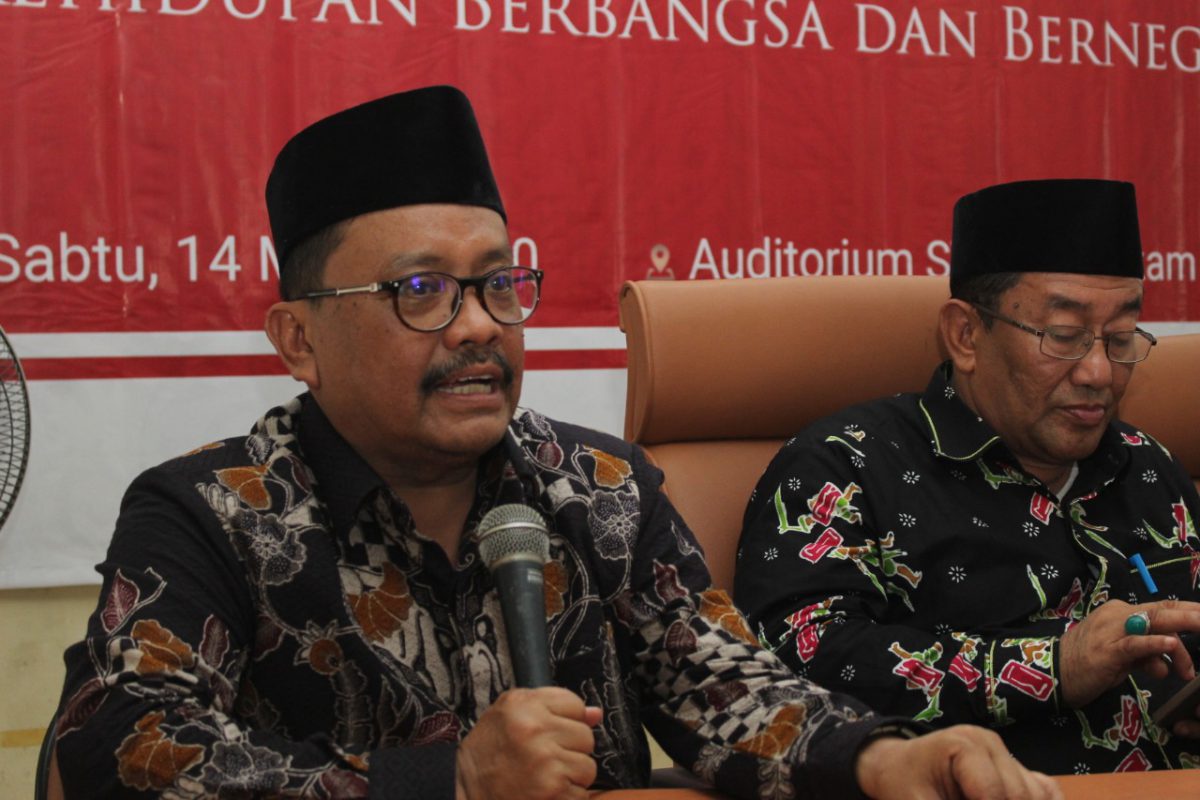
Prof. Masud Said with other speakers in the National Roundtable Discussion at Al-Hikam in Depok
In his presentation during the second session, following the session addressed by the BPIP Head. Prof. Mas’ud Said argued that Pancasila must be strengthened from the structural level of its governing body, and that it requires central iconic figures of authority, akin to the role once played by President Soeharto and his cabinet.
“We are currently impoverished of iconic Pancasila figures,” he said. The institutional apparatus that once drove Pancasila education such as the Agency for Guidance on the Implementation of Pancasila Principles (BP7), active during the New Order era no longer exists. Nor does a comprehensive Pancasila-based policy framework equivalent to the former State Policy Guidelines (GBHN).
Prof. Mas’ud elaborated that strengthening the implementation of Pancasila rests upon the collective will toward unity, Pancasila-based leadership, and the institutional support required to put Pancasila into practice. “This cannot be the responsibility of the state alone. It must be a shared obligation of all components of society,” he affirmed.
Prior to Prof. Mas’ud Said’s address, Prof. Yudian underscored that Indonesians today must take pride in and continue the struggle of the youth of previous generations, as embodied by the Youth Pledge (Sumpah Pemuda) in the fight for independence.
“The Youth Pledge is one of the seeds of national unity that can be called a miracle. Its words are brief, yet they have the power to silence anyone who dares oppose them,” Yudian declared.
He further stated that the highest unifying force of the nation, as well as the source and purpose of Pancasila, can be found across the six sacred scriptures of religions constitutionally recognised in Indonesia. “The source and purpose of Pancasila can be found in the six religious scriptures present in Indonesia. Pancasila is, at its core, religious,” he explained.
Prof. Yudian concluded by affirming that realising the aims of Pancasila demands humanity that every individual must carry within themselves a genuine sense of humaneness in order to bring Pancasila’s ideals to fruition. (AL/PPS)
