
 Indonesia
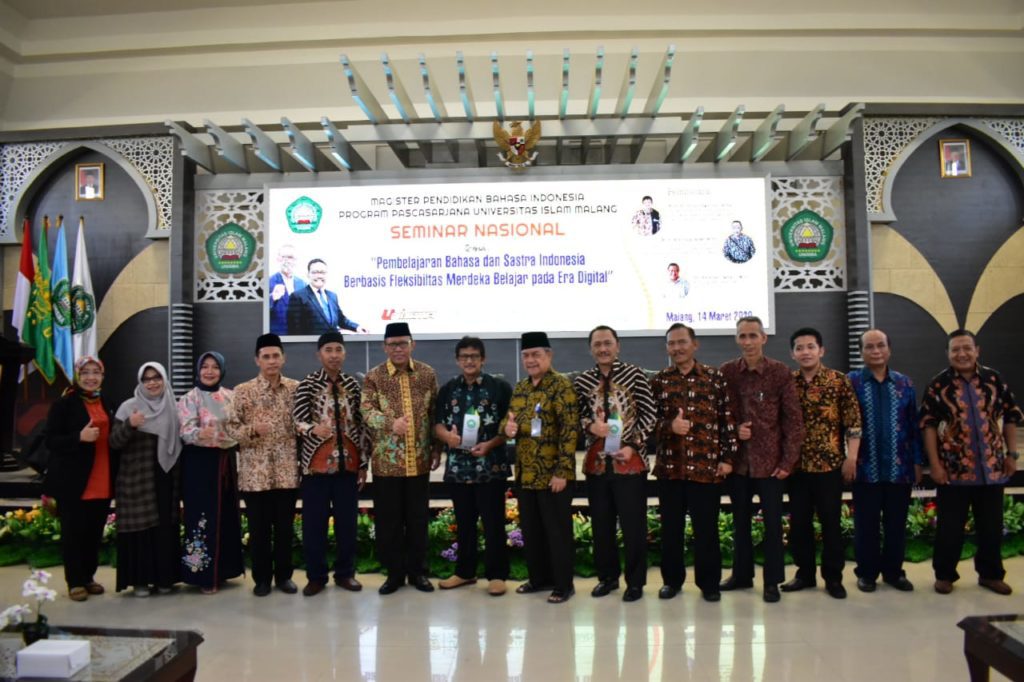
Prof. Dr. Djoko Saryono, M.Pd., asserted that the concept of “freedom to learn” (merdeka belajar) is far from a new idea. He elaborated on this notion during a National Seminar hosted by the Master’s Program in Indonesian Language Education at the Universitas Islam Malang. The senior professor from Universitas Negeri Malang presented a comprehensive examination of the concept’s significance as explored by leading educational theorists.
The National Seminar was held under the theme “Indonesian Language and Literature Learning Based on the Flexibility of Merdeka Belajar in the Digital Era.” Other speakers at the event included Dr. Nur Fajar Arief, M.Pd., moderated by Dr. Akhmad Tabrani, M.Pd., while Prof. Djoko’s session was moderated by Dr. Ari Ambarwati, SS, M.Pd.
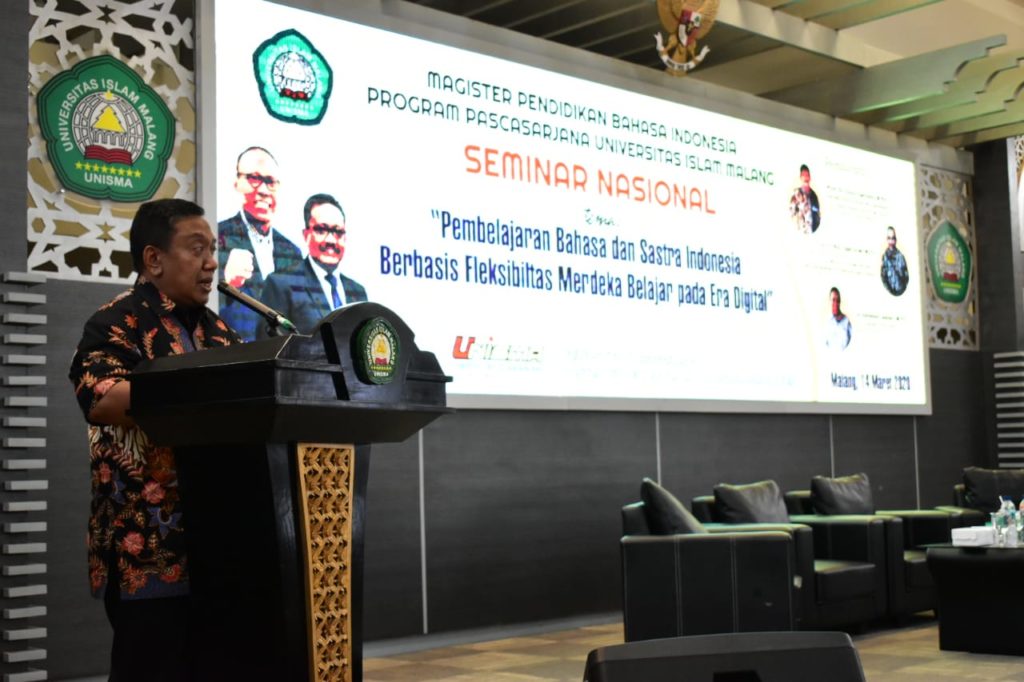
Dr. Akhmad Tabrani, M.Pd., delivering his remarks
The event received the full support of UNISMA’s leadership. UNISMA Rector Prof. Dr. Maskuri, M.Si., noted that prior to the formal introduction of the merdeka belajar policy, Rectors of both public and private universities had been consulted and their input sought.
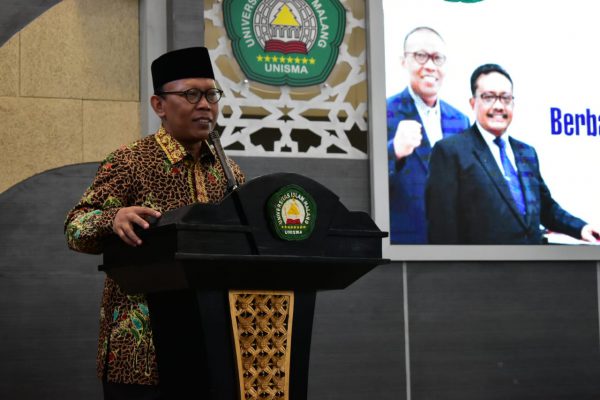
The UNISMA Rector delivering his remarks and officially opening the event
Prof. Djoko affirmed that ideas surrounding freedom in learning have a long intellectual history from John Dewey in 1939 through to Paulo Freire’s seminal work, A Pedagogy of Liberation. Freire, he noted, critically interrogated the very concept of freedom, posing two fundamental questions: first, why do we need freedom in learning? And second, are we still experiencing a form of subjugation in learning?
What, then, is the conception of freedom in learning? According to Prof. Djoko, merdeka belajar represents a balanced state between “freedom from” and “freedom to.” Achieving this requires pre-conditions that genuinely support the intended learning process. Once those pre-conditions are established, the core components freedom to learn, learning autonomy, the courage and enthusiasm to learn, and a love of learning — will naturally take shape. Merdeka belajar can thus thrive within an ecosystem that is open, inclusive, multi-directional, and integrated.
Read also: UNISMA Anniversary: Postgraduate School Holds Online Qur’an Completion Recitation
The second speaker, Dr. Nur Fajar Arief, addressed the challenges of learning in the Industry 4.0 era. “In this era, learning must reference 21st Century competencies, among them: critical thinking, creativity, collaboration, and communication.” Several ministerial regulations on education have also been refined to incorporate these four pillars of the 4C framework, with each regulatory provision elaborated accordingly.
In the context of classroom learning, he highlighted key shifts in collaborative and scientific learning approaches. For instance, the detailed breakdown of the observation stage within the 5M learning model. The act of observing, he explained, can be further delineated into seeing, listening attentively, and careful examination. Through this levelling approach, it is hoped that a more measurable assessment framework can be applied to evaluate student performance. (AL/PPS)
